
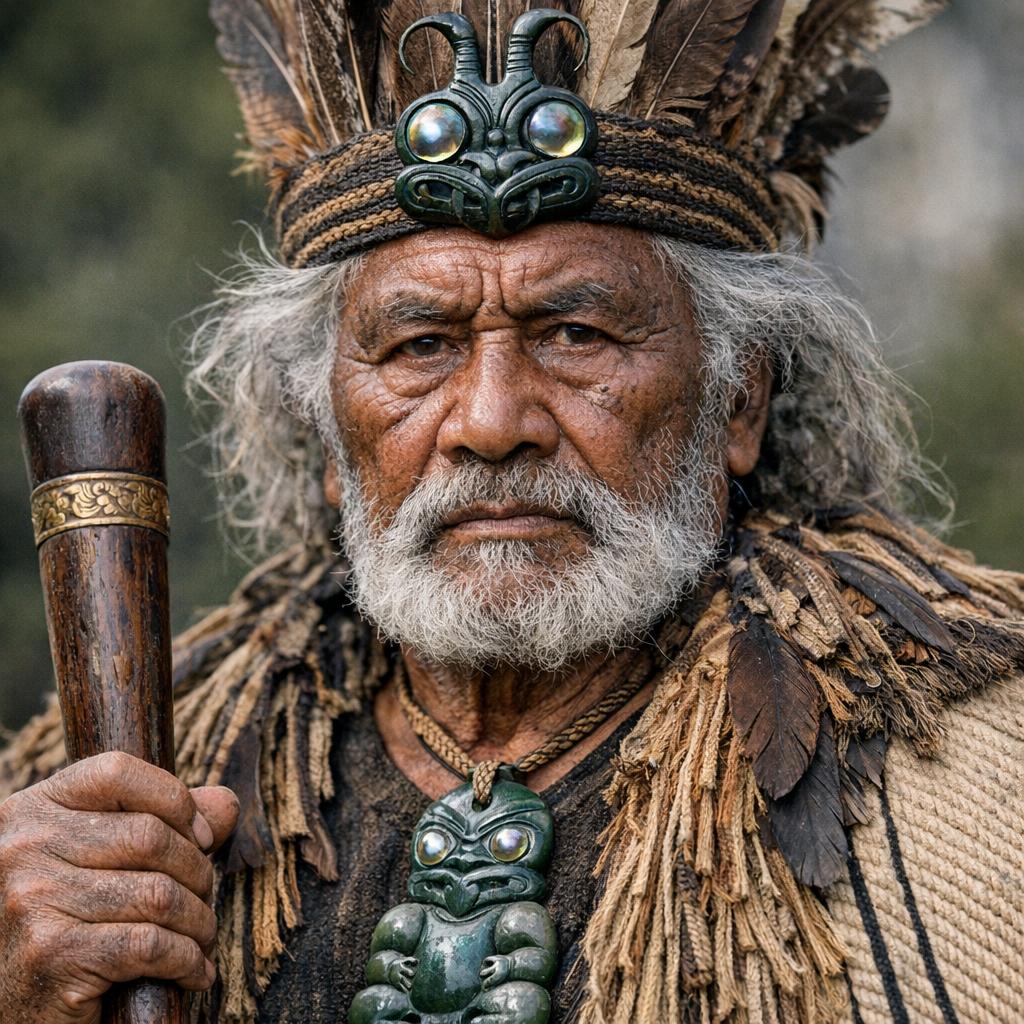
Pōtatau Te Wherowhero
Born: c. 1770–1800
Known for: Prominent Māori chief of the Waikato iwi and became the first Māori King (Kīngi) in 1858.
Died: 25 June 1860
Age: c. 85
Allegiance: Waikato-Tainui iwi (tribe); Kīngitanga (Māori King Movement)
Conflicts: The Musket Wars (c. 1807–1840)
Opposition to Crown Land Seizures: He strongly protested British plans to claim "uncultivated" Māori land as Crown property. When Governor George Grey used the metaphor of a "fat cow" (resources) to imply Māori would eventually have to rely on the Crown, Pōtatau defiantly replied, "I will eat you," signaling his rejection of British dominance.
Establishment of the Kīngitanga: In 1858, he was selected as the first Māori King to provide a unified front (kotahitanga) against the rapid alienation of Māori land. While he maintained he was not challenging Queen Victoria's authority, the British viewed the Kīngitanga as a direct act of rebellion.
The Prelude to the Waikato War: Tensions peaked in 1860 when Waikato supporters went to aid Taranaki tribes in their fight against the Crown. Although Pōtatau died in June 1860 before full-scale war reached the Waikato, his movement became the primary target of the Invasion of the Waikato launched by Grey in 1863.
Cause of Death: Pōtatau Te Wherowhero died of natural causes related to his advanced age on 25 June 1860. As he was roughly 85 years old at the time, his death was anticipated; he had initially been reluctant to accept the kingship just two years earlier, famously stating that his "time was ending".
Resting Place: Mount Taupiri, a mountain close to his royal residence in Ngāruawāhia.
Spouses: Whakaawi, Raharaha, Waiata, Ngawaero
Pōtatau Te Wherowhero (died 25 June 1860) was a Māori rangatira who reigned as the inaugural Māori King from 1858 until his death. A powerful nobleman and a leader of the Waikato iwi of the Tainui confederation, he was the founder of the Te Wherowhero royal dynasty. His 1858 coronation followed years of efforts to create the Kīngitanga, a Māori monarchy intended as an equivalent of the British monarchy, and to foster Māori nationalism against settler encroachment.
He was first known just as Te Wherowhero and took the name Pōtatau after he was crowned. As disputes over land grew more severe, Te Wherowhero found himself increasingly at odds with the Government and its policies. Although he accepted the throne reluctantly and reigned only briefly, he has been credited with establishing a number of historical precedents for the Kīngitanga that survive today, as well as more broadly for the rise of pan-Māori identity.